
Although the first recorded mention of glassmaking in Murano dates back to 982, chandeliers came along much later.
It wasn’t until the early 18th century that the first grand Venetian chandeliers appeared, thanks to a master glassmaker who would become a legend: Giuseppe Briati.
In the 1730s, he established the design that would become the hallmark of Murano glass chandeliers:
– A baluster-shaped central stem.
– Gracefully curved arms.
– And blown-glass floral decorations (flowers, leaves, fruit, droplets, etc.).
These chandeliers would become one of the decorative signatures of Venetian palaces, particularly the most famous of them all, “Ca’ Rezzonico (more on that below).
And since the 1730s, these techniques have remained unchanged, passed down from generation to generation. The island of Murano remains the only place in the world where these chandeliers are still crafted according to the traditional art.
Over more than 300 years of history, several iconic styles have emerged. We can group them into four main categories:
Remember the “Ca’ Rezzonico” palace we just mentioned?
Well, it gave its name to the most iconic, most widespread (and oldest) silhouette in Venetian chandelier design:
The Rezzonico chandelier, recognizable by the features mentioned above:
– A blown-glass central stem shaped like a baluster.
– Curved arms.
– Often adorned with floral decorations: flowers, leaves, fruit, and droplets.
– Or enhanced with 24-karat gold on the most prestigious pieces.
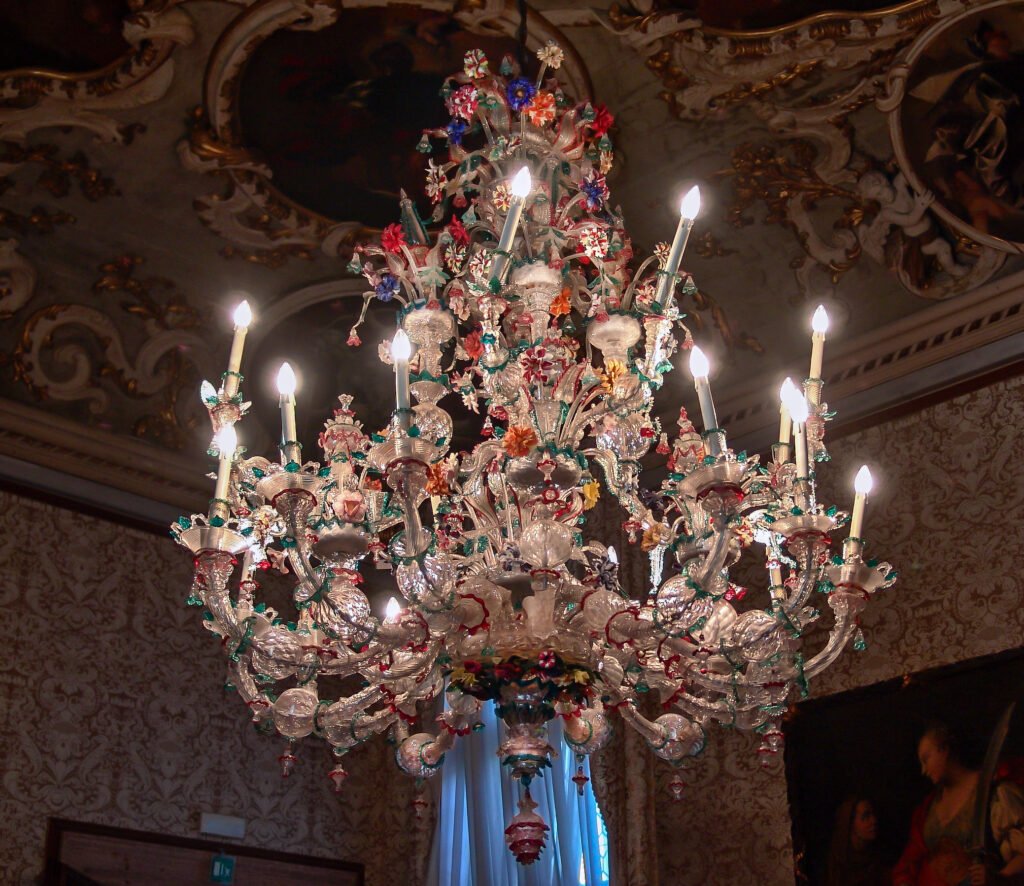
Here’s an example displayed in the “Brustolon” Room of the “Ca’ Rezzonico” palace:
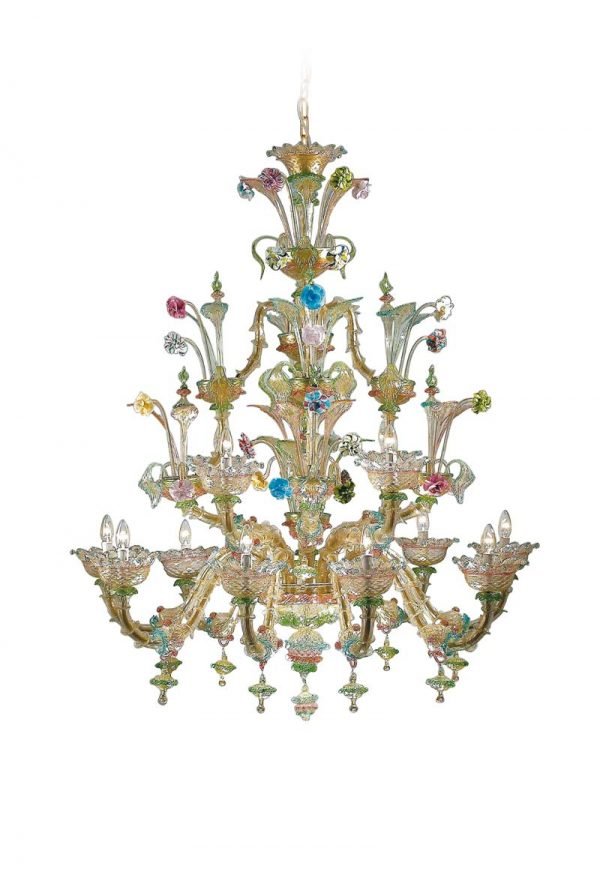
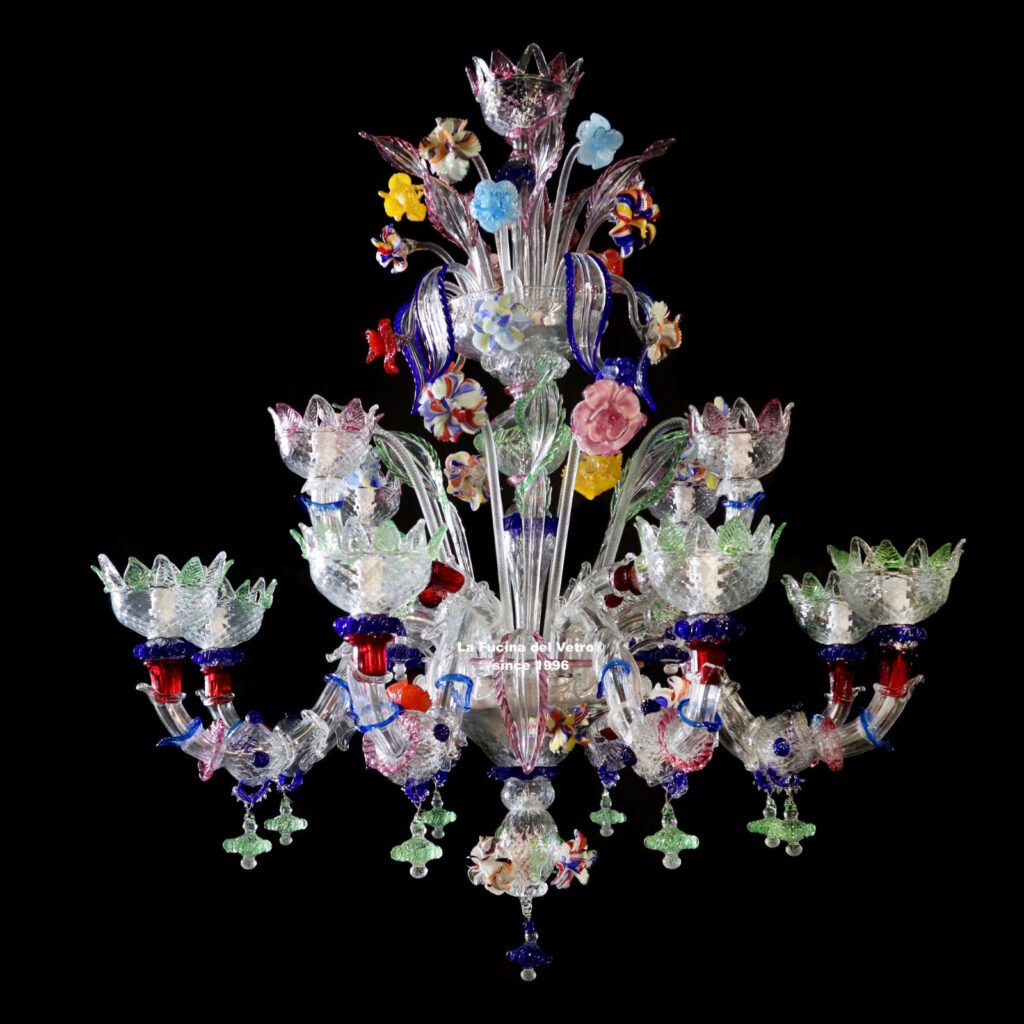
And here are two examples made by Fornacemian & La Fucina Del Vetro, respectively, two certified glassmakers on the island that we work with:
We could just as easily have grouped this style with Rezzonico, since their silhouettes are so similar (baluster-shaped central stem, curved arms, floral decorations).
The only difference?
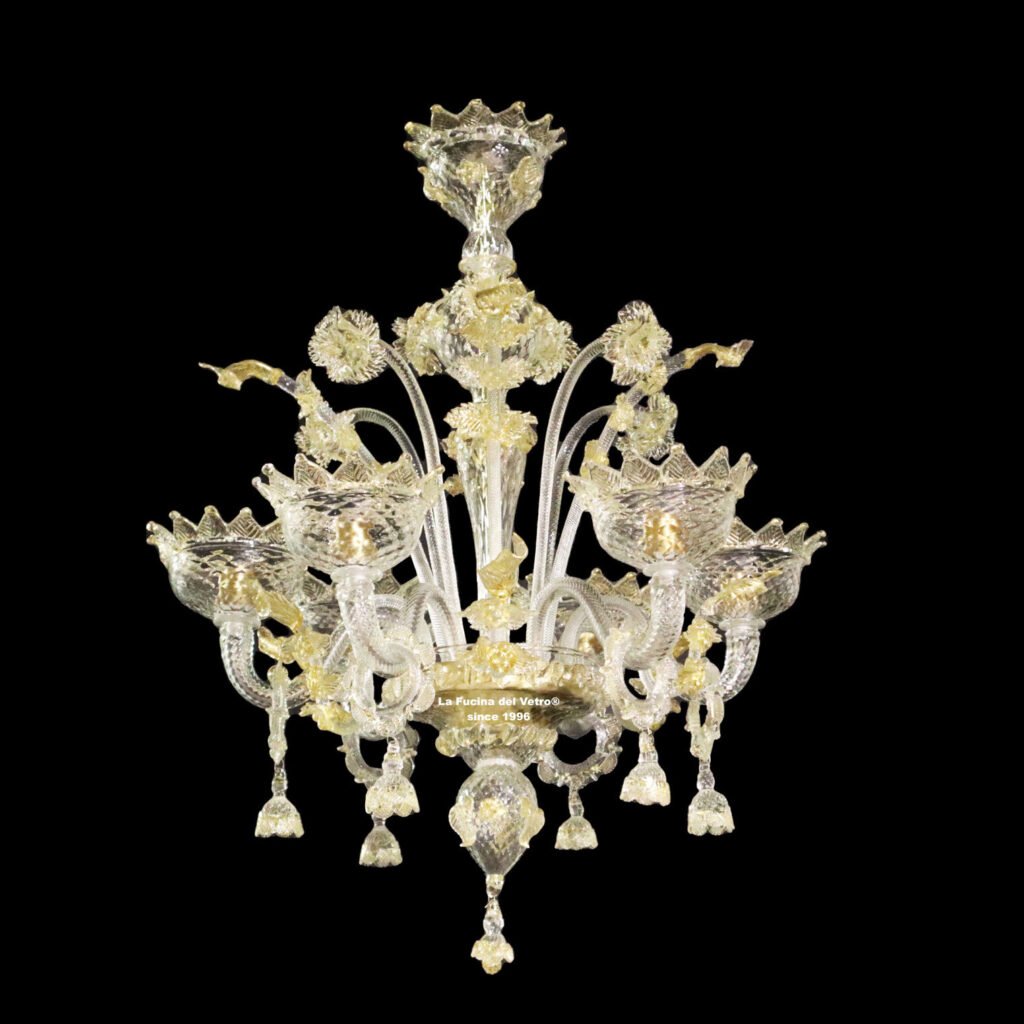
A more restrained style compared with Rezzonico’s lavish ornamentation = fewer decorative elements. Just a few carefully placed flowers and leaves.
The result?
An elegant silhouette, instantly recognizable as Venetian and perfectly suited to most interiors.
Here are two examples made by La Fucina Del Vetro, a certified island glassmaker we work with:
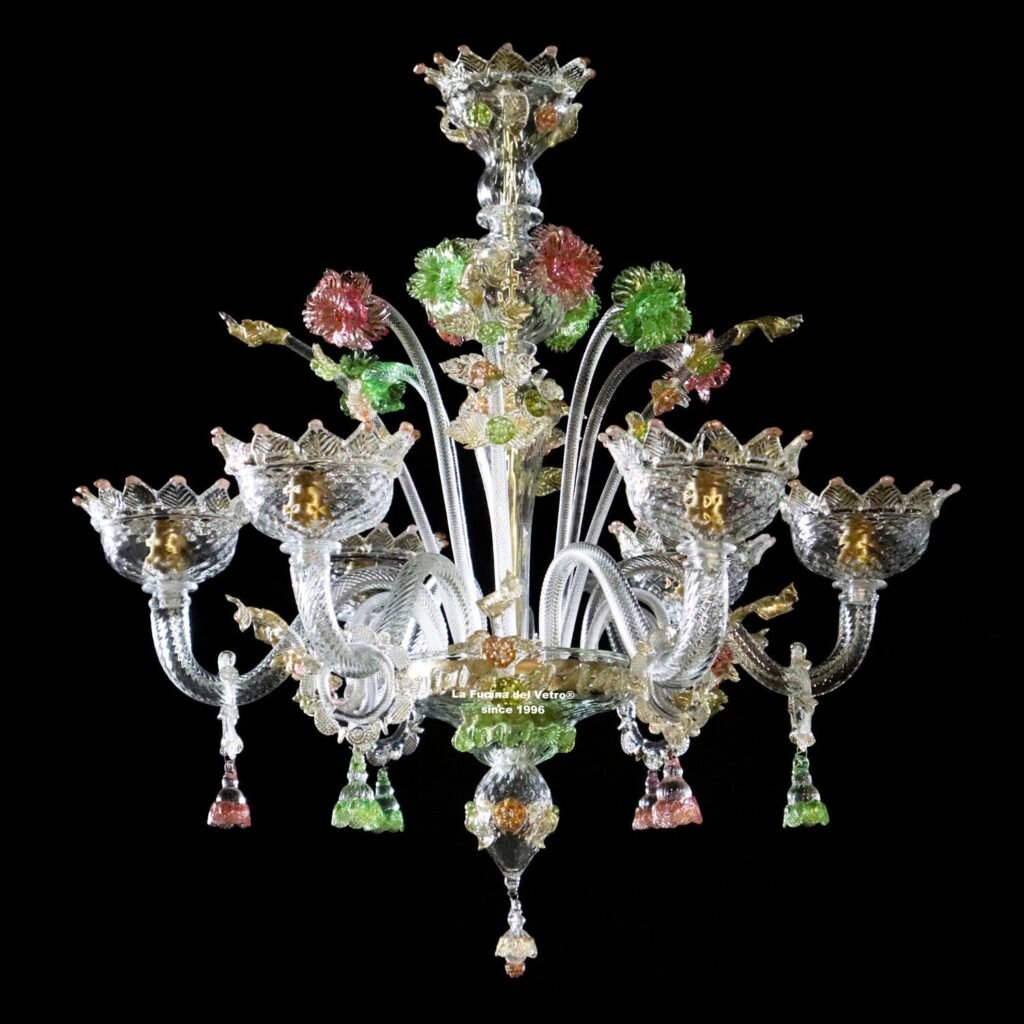
Instantly recognizable, this style is characterized (as you’ve probably guessed) by its large floral & fruit decorations and its exceptionally vibrant colors:
From first to last: the “Flora” chandelier by certified glassmaker Fornacemian, the “Girasoli” chandelier by certified glassmaker La Fucina Del Vetro, and the “Roseto Verde” chandelier by the same glassmaker.
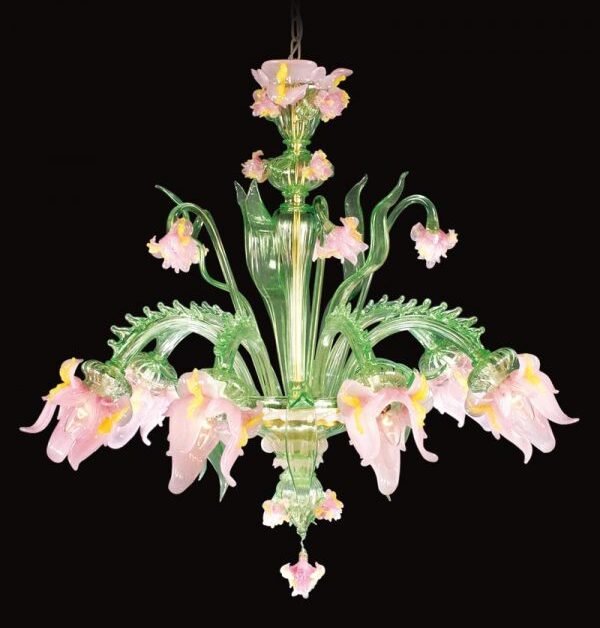
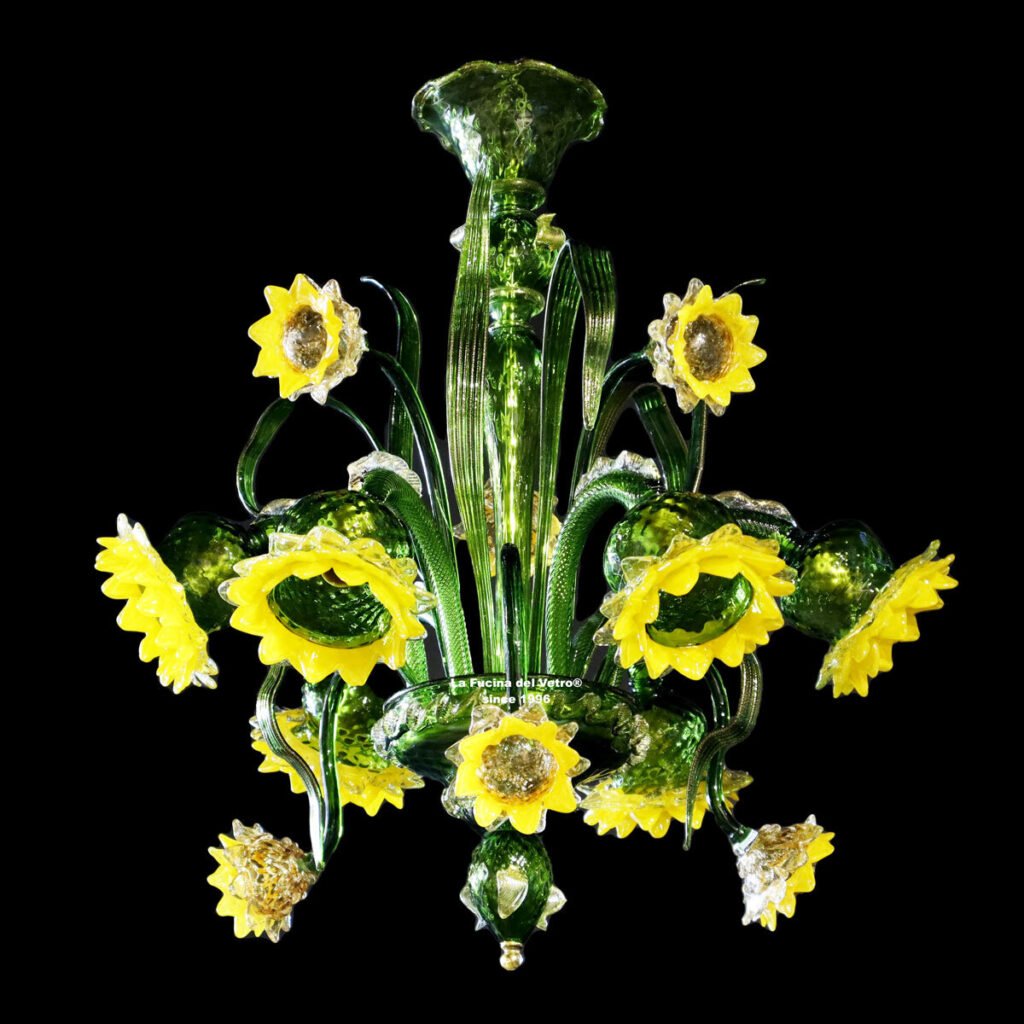
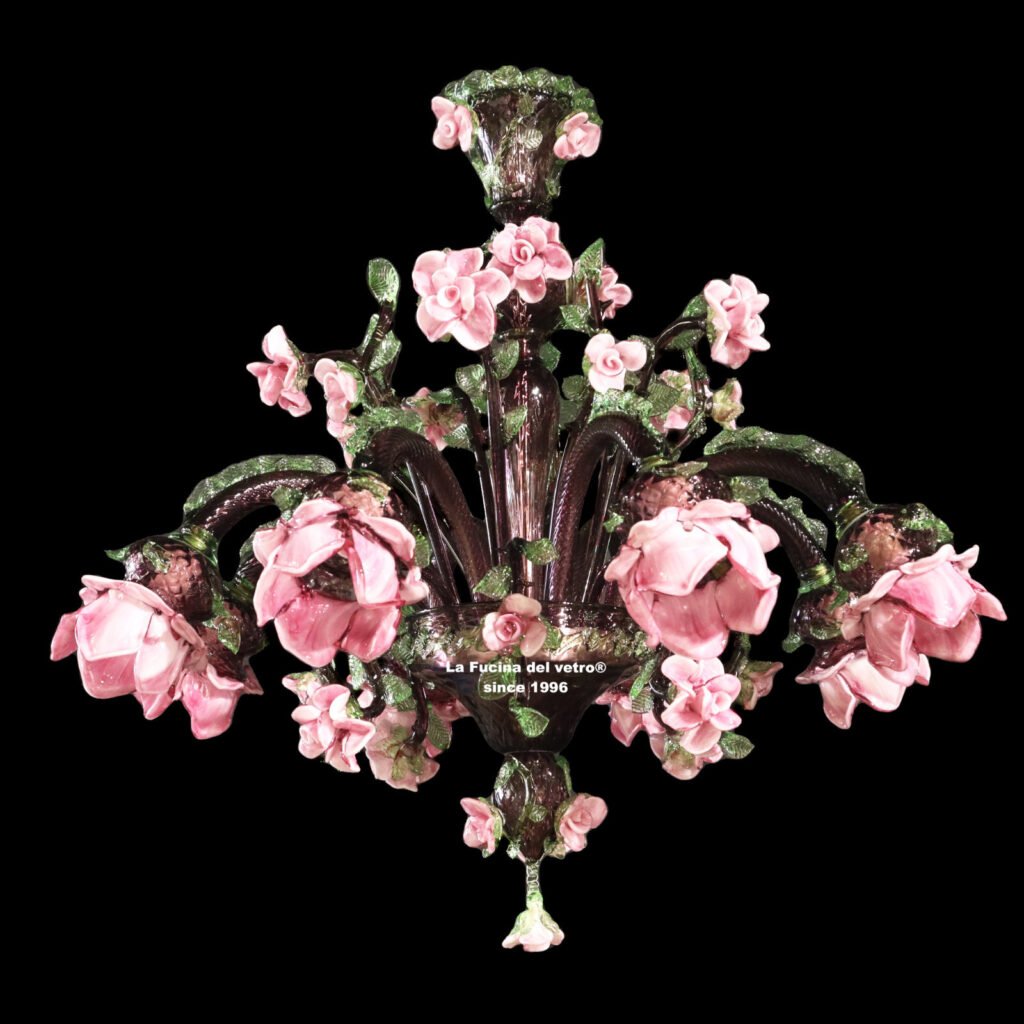
A style that would be particularly well suited to a grand formal dining room, for example.
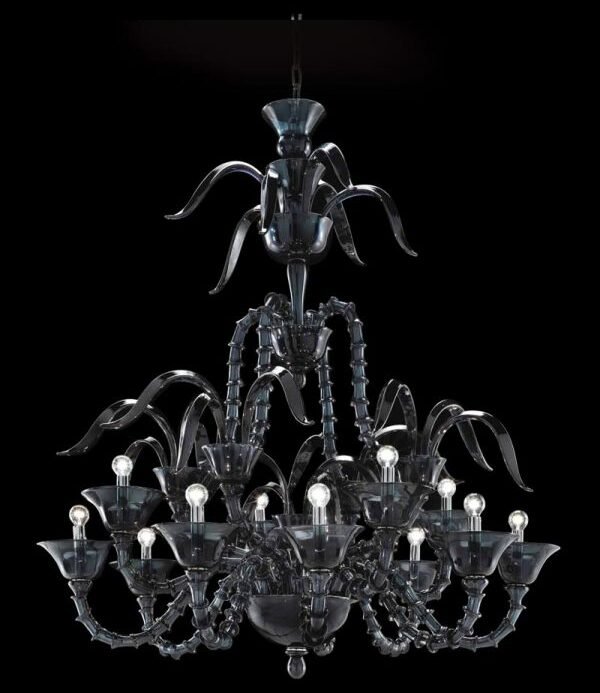
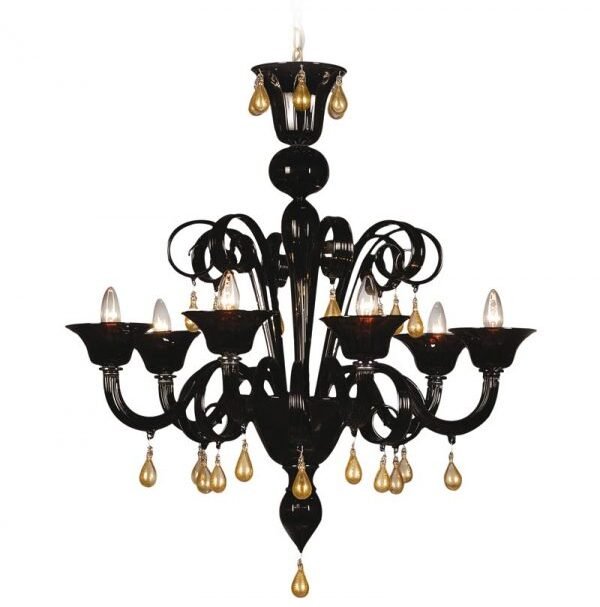
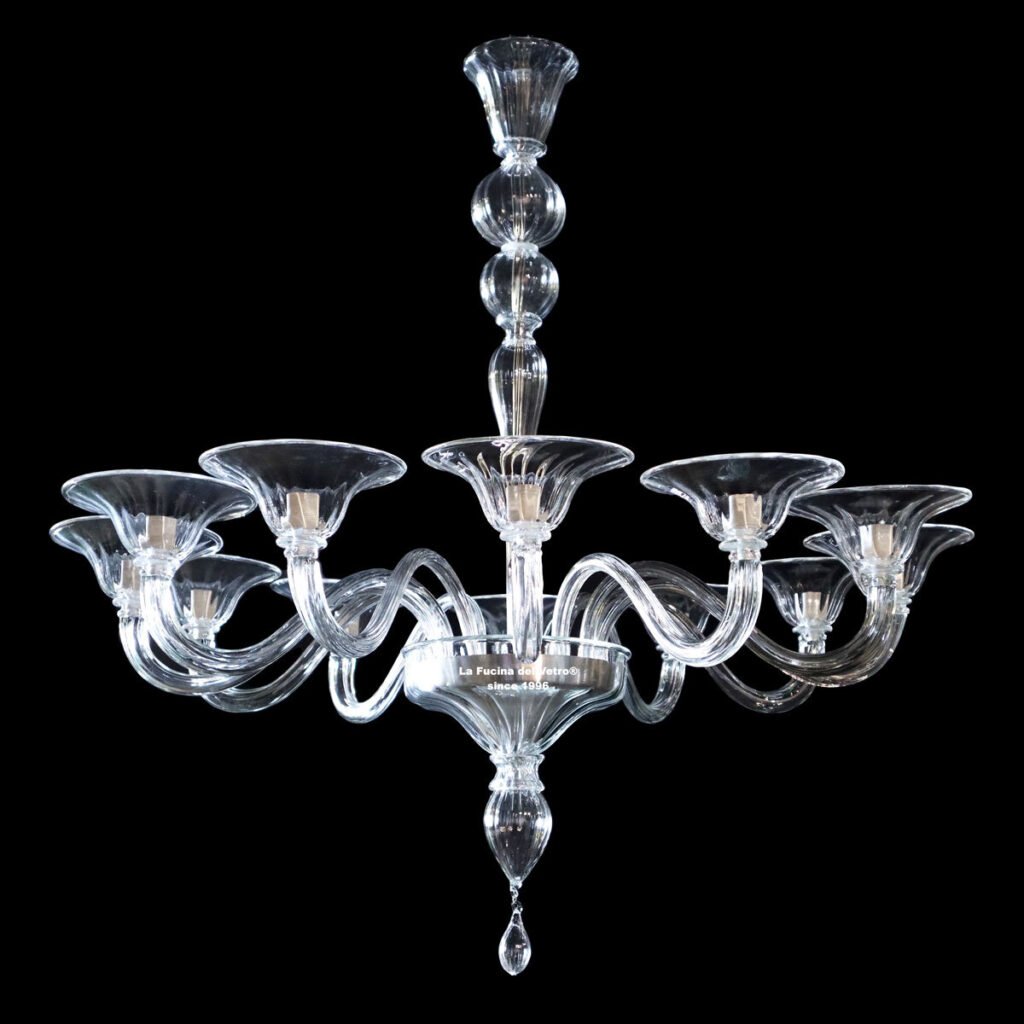
To meet changing customer expectations and complement modern home interiors, Murano glassmakers have also been creating, since the 1950s, contemporary styles with even cleaner lines, minimal decoration, and often solid colors.
The perfect balance between centuries-old craftsmanship (mouth-blowing, hand-shaping) and modern interiors:
From first to last: the “Empire” chandelier by certified glassmaker Fornacemian, the “Manin” chandelier by the same glassmaker, and the “Moderno Pastorale” chandelier by certified glassmaker La Fucina Del Vetro.
Spoiler: yes, there is (and it’s a big one)! Here’s the simple version:
“Venetian chandelier”:
It’s a generic term that can describe a chandelier made in Venice, on the Venetian mainland, or even in Asia (because some sellers aren’t above playing with the distinction between “Venetian chandelier” and the implied “Venetian-style chandelier”). And since the term isn’t protected, it can be difficult for a non-expert to tell an authentic, handcrafted chandelier from Murano apart from a factory-made imitation.
Our advice in this situation:
If a website simply says “Venetian chandelier” or “Venetian-style chandelier” without specifying its exact origin: it’s a scam in 99% of cases.
“Murano glass chandelier” :
In this case, the term “Murano glass” is protected by the Veneto Region and Consorzio Promovetro Murano through the Vetro Artistico® Murano certification. As such, only a chandelier made on the island of Murano by one of its 35 certified glassmakers can legitimately bear that name.
Our advice:
If a website advertises a “Murano glass chandelier” or a “Made in Italy chandelier” without proving its origin by providing the producing glassmaker’s certification number, you can be certain it isn’t authentic. It may actually have been made in Murano, by another, uncertified glassmaker, but in the eyes of the Veneto Region, it doesn’t qualify.
To sum up:
✅ A Murano glass chandelier is automatically also a Venetian chandelier (because the island belongs to the Veneto Region).
❌ But a Venetian chandelier isn’t necessarily a Murano glass chandelier.
And our own selection?
It comes 100% from certified glassmakers. See for yourself: every chandelier product page lists the name and certification number of the glassmaker that produced it.
Here’s a simple rule to follow: the chandelier’s diameter should be approximately one-tenth of your room’s diagonal measurement.
Examples:
Your living room measures 4 x 5 m (diagonal ~6.4 m)?
⇒ Choose a chandelier around 60–65 cm in diameter.
Your dining room measures 5 x 6 m (diagonal ~7.8 m)?
⇒ Choose a chandelier around 75–80 cm in diameter.
You have a spacious 6 x 8 m living area?
⇒ Choose a chandelier with a diameter of over 100 cm.
And for exceptionally large spaces (foyers, reception rooms, staircases):
Choose multi-tiered designs that make a statement vertically as well as horizontally.
The number of lights depends on both the chandelier’s size and your lighting needs. And here’s one thing to remember:
💡 Thanks to its blown glass, often colored, a Murano chandelier generally provides much more light than a conventional chandelier with the same number of lights.
To give you a few ideas:
– A 6-light chandelier is ideal for a bedroom, home office, or small living room.
– An 8- to 12-light chandelier is often the classic choice for a living or dining room.
– A 16- to 24-light chandelier is better suited to large rooms, foyers, and grand reception spaces.
Once again, remember one simple rule: the bottom of your chandelier should hang at least ~2.20 m above the floor in a walkway, and at least 75 cm above a dining table.
So, if:
– Your ceiling height is around 2.50 m?
⇒ Choose a ceiling light or a low-profile chandelier that doesn’t hang too far down.
– Your ceiling height is around 2.70–3 m?
⇒ You can opt for a medium-sized chandelier (50–70 cm in total height).
– Your ceiling height is around 3.50 m or more?
⇒ You have more options, since even multi-tiered chandeliers will work well.
Murano glass chandeliers come in dozens of colors, from perfectly clear glass to bold multicolored designs, including gold leaf, amber, ruby red, cobalt blue, and more.
Here are a few common-sense guidelines:
You have a minimalist, contemporary interior?
⇒ Go for a clear or monochromatic chandelier.
You have a classic, richly furnished interior?
⇒ A Rezzonico-style chandelier will be perfect.
You have a low ceiling or a dark room?
⇒ Choose lighter colors that won’t make the space feel even more confined.
When shopping online, the only truly reliable criterion is the presence of the “Vetro Artistico® Murano” certification, together with the producing glassmaker’s identification number.
Use lukewarm water at 30–35°C, a little soft soap, and a soft microfiber cloth. NEVER use hot water or harsh household cleaners. The full cleaning procedure is detailed in this article.
For an authentic, certified Murano glass chandelier, expect to pay at least $700–$800 for smaller models, and over $10,000 for larger chandeliers or those adorned with 24-karat gold.
From 7–12 kg for a small 3- or 4-light chandelier to over 50 kg for grand, majestic designs.
With proper care, a Murano glass chandelier can last indefinitely and stand the test of time. Some examples sold at auction are over 50 or 100 years old and remain fully functional.


