
Crystal vases come in around a dozen main shapes, each designed for a particular type of floral arrangement and decorative purpose.
Knowing these shapes helps you choose a piece that enhances your bouquet rather than constraining it. And one that, in some cases, stands beautifully on its own as a decorative object, with every facet capturing the light, breaking it into a prismatic spectrum, and transforming it into flashes of color.
To help you find the vase best suited to your tastes and needs, here’s a guide to the 6 most common vase shapes:
Tall and slender, this vase is designed to hold a single flower or individual stem. It’s one of the most minimalist shapes on our list: it showcases the graceful lines of a rose, lily, or tulip while emphasizing the verticality of a space.
💡 Ideal for a narrow console table, the corner of a desk, or arranged in a group of three on a mantelpiece.
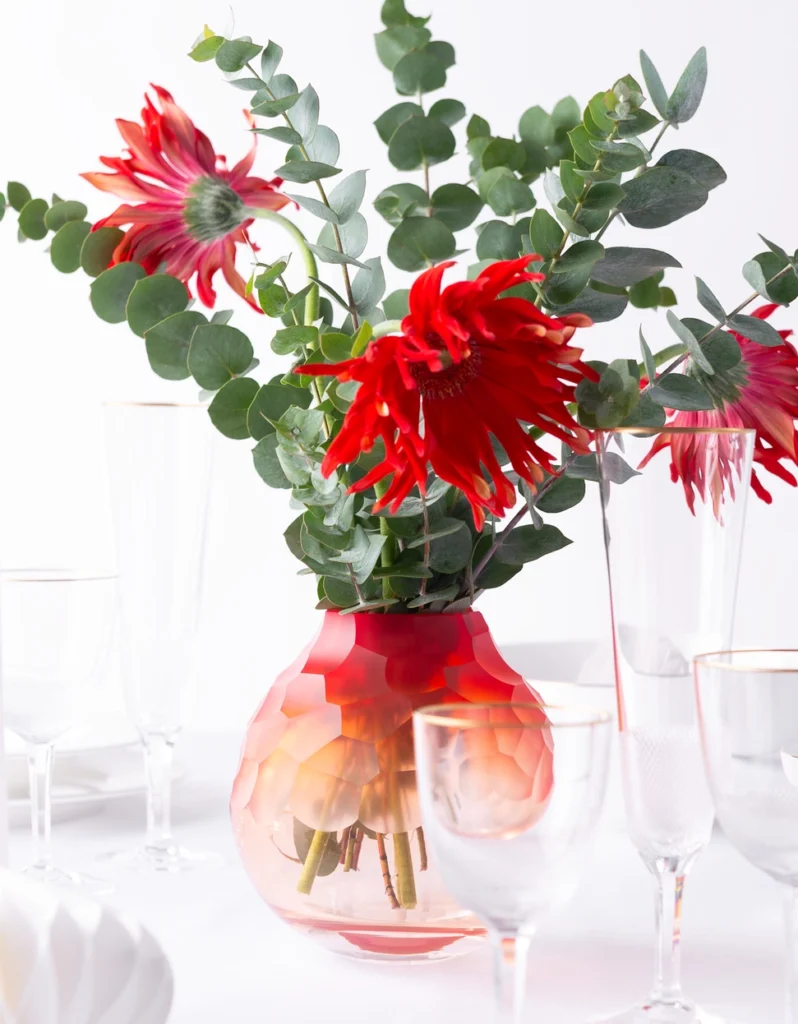
Recognizable by its spherical or open hemispherical shape, the round vase provides excellent support for compact, rounded bouquets & arrangements (e.g., peonies, hydrangeas, English roses). Its narrow neck holds the stems without crushing them, while its wide base (made of crystal) captures and reflects light in every direction.
💡 A piece often used as a table centerpiece. Take our coral-red Dotty vase, for example:
Wider at the top and narrow at the base, the flared vase (also known as a trumpet vase) is ideal for tall, fan-shaped arrangements, such as gladioli, lilies, or loose country-style bouquets. Its silhouette recalls the grand ceremonial vessels of the 18th century.
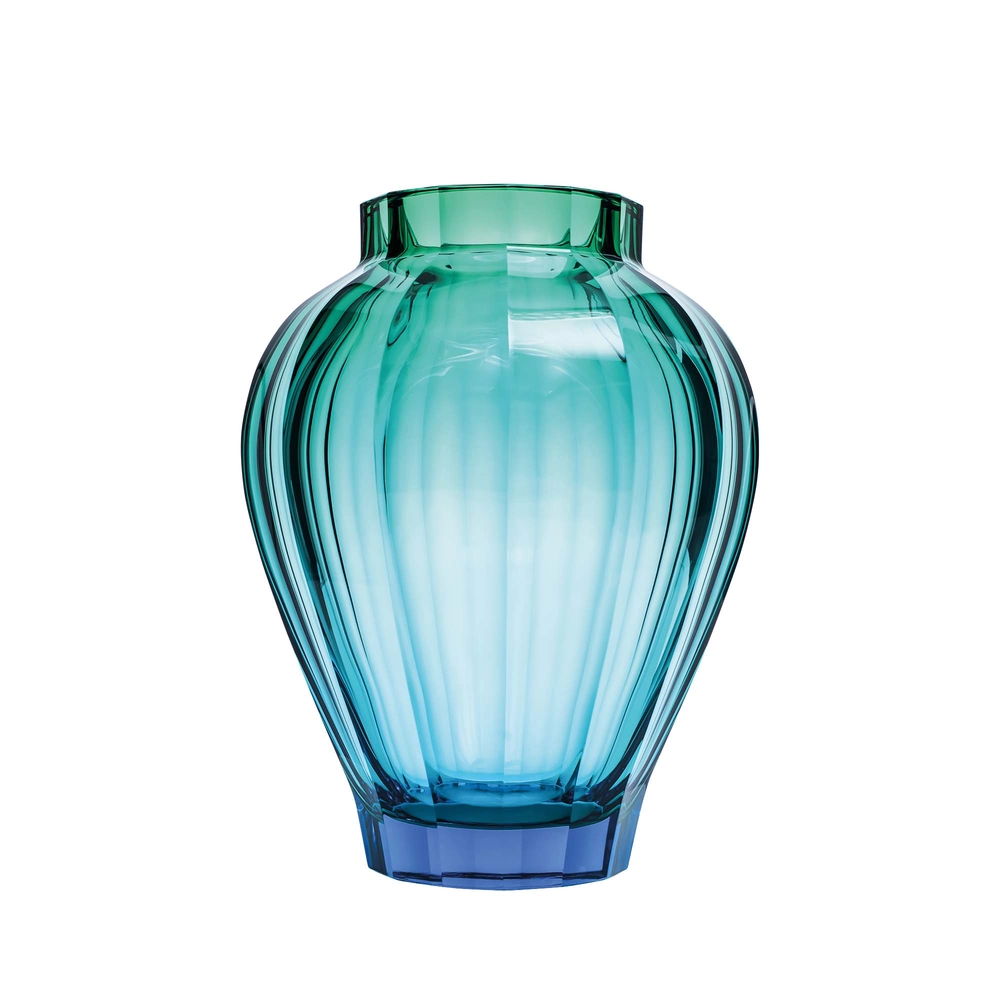
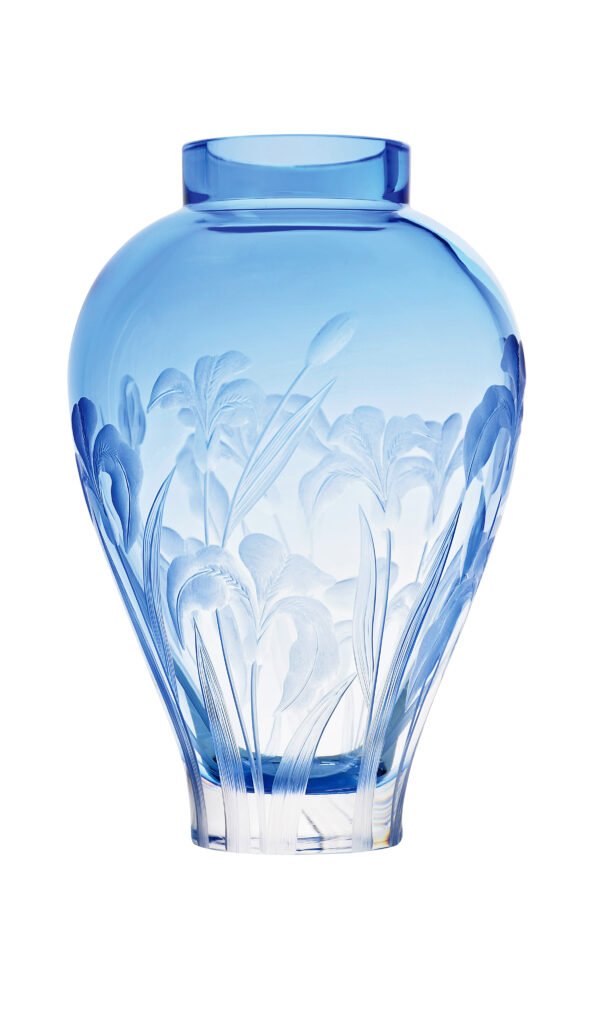
Classic and symmetrical, this vase features a distinctive rounded body framed by a narrower neck and base. A direct legacy of ancient sculpture and Baroque furniture, the deep cuts and decorative details made possible by crystal… turn these vases into magnificent statement pieces in their own right.
💡 Take a look at our magnificent Lirio vase & its version engraved with an iris design.
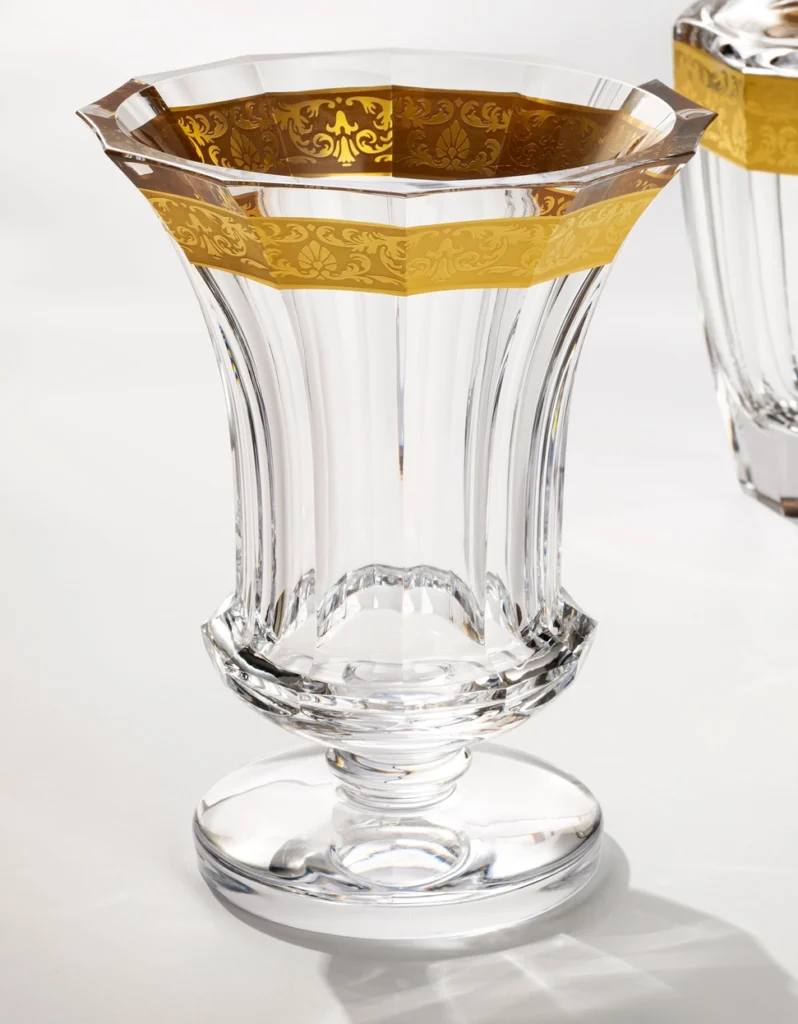
Dating back to ancient Rome and named after Florence’s Medici family, these vases are recognizable by their wide, flared bowl resting on a pedestal, sometimes adorned with handles. Sculptural and monumental, a Medici vase hardly needs flowers to make an impression. It makes a magnificent statement piece on your mantelpiece or in your entryway.
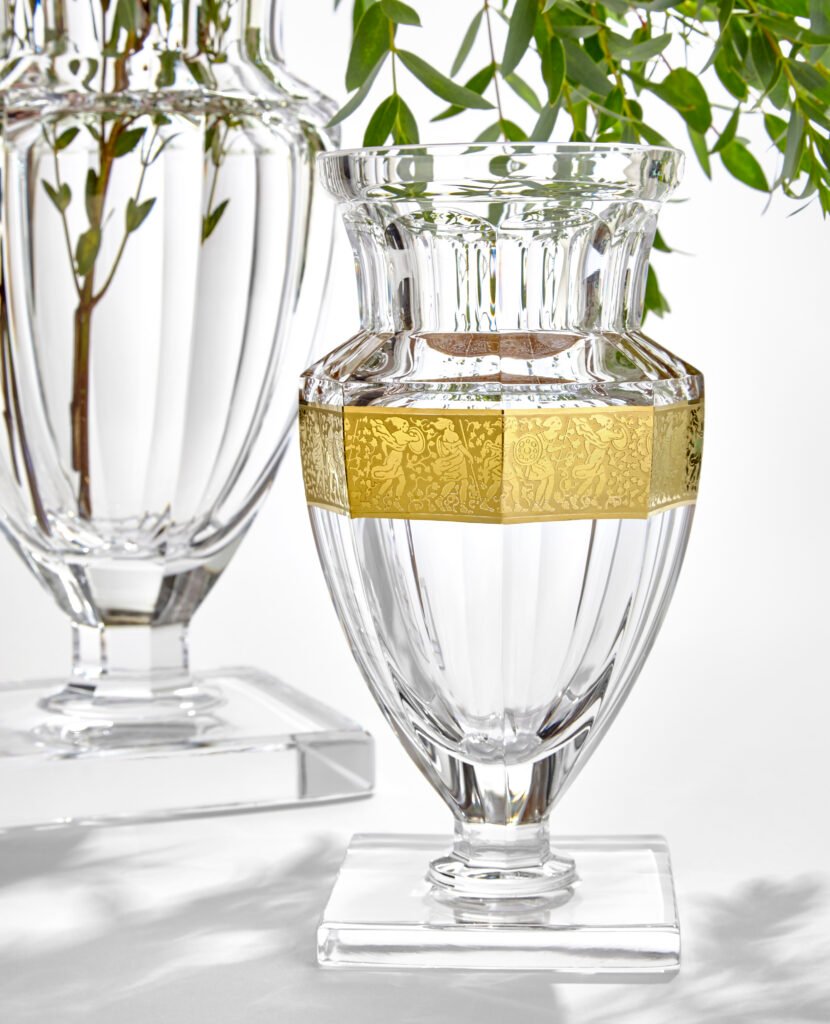
💡 Take our Gloria vase adorned with a band of 24-karat gold, the smaller sibling of the Cleopatra vase by the same house, Moser.
The most contemporary shape in the collection, its name says it all: straight sides, with no defined neck or rounded body. Its simplicity makes it the perfect setting for highly architectural arrangements (eucalyptus branches, monstera leaves, magnolia).
💡 Take our contemporary Daisy vase, or some pieces from our Art Nouveau collection if you prefer decorative designs.
Now that we’ve explored the different vase shapes, how could we overlook the vases that have become icons?
In Europe, 5 great houses account for much of the history of the crystal vase. And no enthusiast can truly claim to know this craft without being familiar with at least their most emblematic creations:
How could we talk about crystal vases without mentioning Daum? A jewel of French craftsmanship, the house elevated pâte de cristal to a sculptural art form. Its vases, created using the lost-wax casting technique, are recognizable by their astonishing realism, subtle shades of color, and characteristic matte finish. It’s difficult to single out just one design, given how many creations the House of Daum has contributed to France’s artistic heritage.
Created in 1927, this now-iconic piece depicts dancing female figures inspired by the ancient Bacchantes, followers of Bacchus, the god of wine. Sensual, intoxicating, mythological: this vase is one of the most celebrated pieces in Lalique’s legacy. We could also mention Lalique’s Serpent vase.
Although Saint-Louis is better known for its collections of crystal glasses, such as the Tommy collection… its Versailles vase, inspired by the ornamental basins in the gardens of the Sun King, has earned a place among the most iconic creations. Why? Its deep diamond cuts and flat facets require no fewer than 6 to 8 weeks of artisans’ work for ONE single piece.
Baccarat is historically known for its monumental crystal chandeliers and its Harcourt collection, which embodies the house’s heritage in drinkware… But the Eye vase, created in 2001, marks its own modern contribution to the art of vase making. Horizontal cuts on the exterior & vertical cuts on the interior intersect to create a rippling prismatic effect, enhanced by clear crystal.
Like Saint-Louis, the Czech region of Bohemia has long been renowned and admired for the quality of its crystal glassware. But with its deep cuts, vibrant colors, and unparalleled engravings, Moser has also made a name for itself in the exclusive world of luxury crystal vases. Pieces collected around the world and presented as diplomatic or royal gifts. To discover the house’s finest creations, we invite you to visit our dedicated selection of Bohemian crystal vases.
For the full explanation, our guide to identifying genuine crystal will be your best ally.
But if you prefer short & straightforward answers, here are 5 authentication tests anyone can try:
1: Weight: a crystal vase weighs approximately 30% more than a glass vase of the same volume.
2: Light: crystal splits sunlight into rainbow-like prismatic reflections, while ordinary glass retains a more neutral appearance. So place your vase under a light source (preferably natural light) and take a closer look.
3: Sound: crystal produces its famous “crystal ring”, a clear, lingering chime. Ordinary glass, on the other hand, produces a rather dull, short sound. However, this test works better for drinking glasses. Since vases are thicker & larger, even crystal may not ring clearly.
4: Finishing: thanks to its composition and the talent of its artisans, a crystal vase will often feature more elaborate details: precise cuts, magnificent engravings, and gold or platinum decoration.
5: Signature: the easiest test, especially if you’re buying a luxury piece, since the great crystal houses sign their creations with an engraved maker’s mark. You’ll often find it underneath the base, though occasionally it appears on the side.
6 (bonus): Price: we’ll discuss this further below, but an authentic crystal vase (mouth-blown & handcrafted) will be considerably more expensive than a glass vase. So don’t expect to find a genuine crystal vase for under €100–€150, even among the smallest models.
When it comes to crystal vases, the secondhand market is full of hidden treasures: family heirlooms, flea-market finds, and auction-house discoveries.
But knowing how to distinguish a valuable piece from an ordinary decorative object requires a few pointers if you don’t want to be taken for a ride.
To be honest with you, identifying an antique piece requires, above all, experience and in-depth knowledge. Especially since, before 1936, few crystal manufacturers systematically signed their creations.
But if you’d like to try your hand at it, here are a few clues to help you authenticate a piece properly:
⇒ A rough pontil mark or a ground and polished area on the base, indicating that the vase was mouth-blown using a blowpipe.
⇒ The presence of tiny air bubbles within the material: a characteristic of traditional handcraftsmanship (and by no means a defect!) not usually found in machine-made glass pieces.
⇒ Subtle irregularities in the cutting: again, because of the artisans’ manual work, no two crystal pieces are strictly identical. So, with a trained eye, you may notice a few irregularities. A characteristic that adds even more value through the human touch, unlike perfectly uniform glass vases, symbols of soulless, mechanical production… by machine.
But the shapes themselves can also help you date a piece. Take, for example, multilayered vases with floral motifs revealed through acid etching, characteristic of late-19th-century Art Nouveau workshops.
Prices vary considerably depending on the manufacturer, period, condition of the piece, and, of course, the buyer’s perspective.
But to give you a general idea:
⇒ An unsigned or damaged antique vase, even one made by a prestigious crystal house, may sell for as little as around €200.
⇒ An antique piece that IS signed by a major crystal manufacturer, on the other hand, can easily command several thousand euros.
⇒ And when it comes to exceptional antique pieces (= limited editions, artist collaborations, extremely rare vases)… the sky’s the limit! Vases can sell for tens (or even hundreds) of thousands of euros, as happened in 2022 when a pair of Baccarat vases sold at auction for €76,450.
There are 3 common ways to do this:
1: The first, of course, is to contact the crystal manufacturer that made it (if you know who that is). Each major house has its own authentication service.
2: The second is through auction houses such as Millon, which often offer free appraisals.
3: The third is through specialists in buying & reselling crystal, such as Prestivilege, which has notably been endorsed by Saint-Louis.
But if you’d like some help, you can also contact us. With over 20 years of experience, we can point you in the right direction (and perhaps even buy your piece if it catches our eye!).
Between the complexity of the cutting, the reputation of the crystal house, and the number of pieces rejected during production… there’s no single price for an authentic crystal vase.
To help guide you, here are 3 price ranges to keep in mind:
⇒ For the smallest models or simpler shapes, expect to pay at least $200 to $900.
⇒ For more elaborate pieces (cut, engraved, adorned with gold or platinum decorations), or smaller versions of iconic vases, expect between $1,000 and $4,000.
⇒ And for iconic or exceptional creations, prices start above $4,000 and can soar beyond $200,000 at Daum. A more realistic range? Between $4,000 and $15,000.
Expensive prices, certainly. But they, beyond reflecting the prestige of exclusivity & elitism, above all represent the unmatched skills of the artisans and the enormous amount of work involved.
Keep in mind that making just ONE medium-sized vase from a renowned crystal house can require around ten artisans and 3 to 7 weeks of work. A complexity we explore in our article on how crystal is made.
Beyond being a decorative object or a beautiful setting for a bouquet, crystal vases also make exceptional gifts when you want to mark an important occasion.
A gift first associated with marriage through the tradition of the “bridal vase”:
A French tradition practiced between 1850 and 1930, in which someone close to the couple would give a set of 3 vases: one large vase for the bride and two smaller ones for the best man & maid of honor. And while most of these vases were made of porcelain, crystal was also used, particularly among wealthy families. And there’s nothing stopping you from bringing this tradition, largely forgotten after World War I, back to life!
Or associated with crystal wedding anniversaries:
The 15th wedding anniversary is traditionally celebrated with crystal. Both brilliant and fragile, crystal symbolizes the precious bond a couple has built and must continue to protect.
But a crystal vase isn’t just a wedding gift! It also makes an ideal present for:
– Milestone birthdays.
– Retirement.
– A high-end “business” gift.
In short, it remains one of the most universally appreciated gifts: it can be passed down through generations, gain sentimental value, and eventually become… a treasured family heirloom.
5 golden commandments to remember:
1: By hand, you shall always pamper it.
2: With lukewarm water, you shall always wash it.
Crystal is sensitive to thermal shock. Water that’s too hot can cause it to crack. Instead, use lukewarm water, around 30–35°C, with a few drops of soft black soap.
3: With a soft sponge, you shall always clean it.
Abrasive sponges leave tiny scratches on crystal.
4: Immediately, you shall always dry it.
To prevent mineral deposits left by tap water. For drying, use a clean microfiber (or linen) cloth.
5: Every 2 weeks, you shall clean it.
To prevent mineral deposits from the water and the cloudy film mentioned below, remember to change the water + clean your vase at least every 2 weeks.
Cloudiness in a crystal vase is almost always caused by stagnant water left inside for too long.
And to tackle it, there’s nothing better than the white vinegar method explained in our article on cleaning crystal.


