Free shipping – Breakage protection included – No minimum order
A crystal decanter is one of the most enduring and personal pieces you can acquire, embodying the symbolism of fine living, the practical pleasure of serving, and the legacy of a piece meant to be passed down from generation to generation.
Whether you’re looking for a wine decanter, a whiskey decanter, a water carafe, or a cognac & liqueur decanter… you’ll find a piece here that honors what you serve just as much as the table you serve it on.
❌ No endless catalogue of low-priced options.
✅ But a carefully curated selection of hand-blown & handcrafted crystal decanters that places artisanal excellence above marketing.
And to complete your set, discover the World of our crystal glasses.
Showing all 7 results
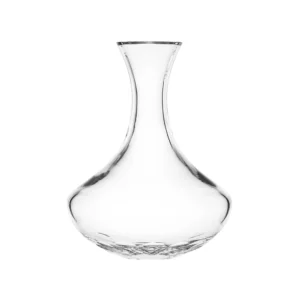
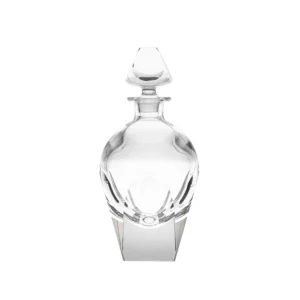
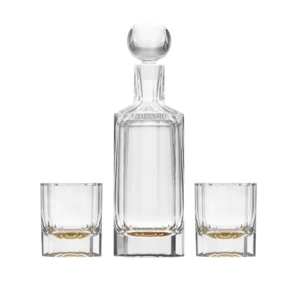

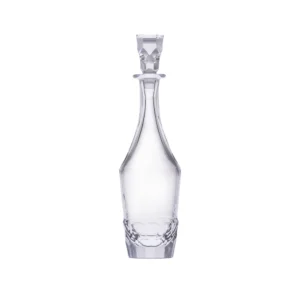
A crystal decanter is only worth choosing if it suits what you plan to serve in it. Its shape, capacity, neck width, whether or not it has a stopper: every detail matters.
To help you choose, here’s a short guide to the 4 main types of decanters & carafes and how to use them:
There are two very distinct uses to consider here:
1st use: Aerating a young wine to release its aromas, using a decanter with a wide base, flared neck and NO stopper.
2nd use: Separating an aged vintage from its sediment, using a decanter with a narrow base, tapered neck and stopper.
Two very different purposes, requiring two very different decanters.
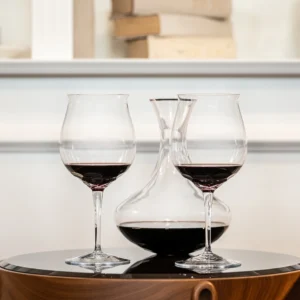
For everything you need to know, explore our selection of crystal wine carafes & decanters.
For an elegant whisky service, a decanter with a stopper is essential to preserve its aromas and prevent them from evaporating. Unlike wine, whisky doesn’t need aeration here: just a beautiful presentation and proper storage.
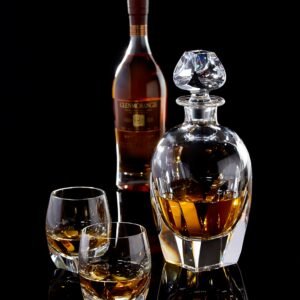
To narrow down your search, discover our selection of crystal whisky decanters.
For everyday serving: still water, sparkling water, juices, soft drinks. The main consideration here is a generous capacity (between 1 L and 1.5 L), while a stopper is optional. Some designs, such as Moser’s Optic or Mozart, feature a handle for a more comfortable grip.
Easily recognised by their “squat” bases, these decanters are, as a general rule, smaller (around 75 cl in capacity) and fitted with a precisely crafted stopper to minimise alcohol evaporation. Ideal for presenting your finest spirits during an after-dinner tasting. Want to add a touch of elegance and understated luxury to impress your guests? Take a look at our Splendid crystal cognac & brandy decanter. A collection famously given in 1947 as a wedding present to the future Queen of England, Elizabeth II.
You’ll find more details on the respective decanter pages. But in short:
⇒ For serving wine, allow 1 L to 1.5 L for a standard 75 cl bottle (the extra space allows proper aeration).
⇒ For whisky, it’s the opposite: the decanter should be almost completely full to limit contact with air. So opt for a 75 cl decanter if you only drink whisky occasionally, or 1 L to 1.5 L if you’re a true enthusiast.
⇒ For everyday serving of water, juices and soft drinks, choose 1.5 L to 2 L.
⇒ And for brandies, liqueurs & spirits, 75 cl is more than enough.
Choosing between a cut crystal decanter and a plain crystal decanter is above all a matter of aesthetics and how you intend to use it.
Here are the two styles, and who they’re best suited to:
Hand-cut using centuries-old craftsmanship, they feature deep facets: diamond cuts, bevels, stars, flat cuts and sometimes even floral motifs. The effect? The crystal catches the light and breaks it into colorful reflections, turning the decanter into a decorative piece in its own right, even when empty. Ideal for anyone who loves the play of light.
With no decorative cutting, they let the purity of the crystal speak for itself: smooth surfaces, fine walls and clean lines. The effect? Quiet elegance. Instead of playing with light through its facets, the crystal relies on its absolute transparency to showcase what’s inside your decanter: the colour of a wine, the amber hue of a whisky, and so on. An ideal choice for those who prefer simplicity, or who believe it’s what’s inside the decanter that matters most.
The price of a crystal decanter ranges from $500 for simpler designs to over $10,000 for exceptional pieces.
This huge variation comes down to 3 factors: the crystal house (is it a recognized name or not?), the type of decanter (water, wine, whisky) and, above all, the complexity of the cutting and decoration (24-carat gold, engraving, etc.).
It’s therefore difficult to give a single price. But here are a few ranges as a guide:
⇒ For minimalist decanters, expect to pay between $500 and $900 from renowned crystal houses.
⇒ For an iconic decanter or one that’s more complex to produce (finely cut and/or decorated with 24-carat gold), expect to pay around $1,000 to $2,000–$3,000 from renowned crystal houses.
⇒ And for exceptional pieces, limited editions or designs signed as part of artist collaborations, there’s virtually no limit. Prices can climb to over $4,000, $5,000… or even $10,000.
IMPORTANT:
We’re talking here exclusively about authentic, handcrafted crystal decanters, made using traditional techniques. Machine-made decanters in crystalline glass are therefore much cheaper: entry-level models can cost less than $100.
Browsing a flea market, attending an auction, or recently inherited an antique decanter?
Before considering it a valuable piece (or giving it a quick clean), here are 3 ESSENTIAL things to check:
Point No. 1: The Maker’s Mark / Signature
Usually found underneath the base or on the side. It’s the quickest & easiest way to tell whether your decanter might be valuable. With one small caveat: very old pieces from Baccarat, Lalique, Saint-Louis and Moser weren’t always signed. Or their signatures may have faded over time. To learn more, we’ve written a dedicated article on identifying crystal pieces.
Point No. 2: Check for Signs of “Glass Disease”
This generally appears as a milky cloudiness, caused by dishwasher cycles, cleaning with chemicals or prolonged contact with an acidic substance. Unfortunately, this cloudy appearance is irreversible in many cases. So be careful before buying a piece thinking “a little elbow grease will make it look brand new”. For the full explanation, read our article on cleaning crystal.
Point No. 3: Avoid Storing Alcohol in It for Several Days
Once you’ve bought your decanter, remember one simple rule: never store alcohol in it for more than 1 week. This also applies to new decanters, but especially to antique ones, as they may contain lead that can leach into the drink with prolonged contact.
Our Final Piece of Advice:
If you’re unsure of its origin or value, always have the decanter appraised by an auctioneer, an antiques dealer specialising in glassware, or contact us directly.
And if you’re actively looking for a crystal decanter with an antique-inspired style, we can wholeheartedly recommend the Baroque carafe by Moser. Certainly an expensive piece, but truly one of a kind!
As we mentioned earlier, a crystal decanter is one of the most enduring and personal gifts you can give (or treat YOURSELF to!).
Consider:
– The symbolism of the French art of living, admired around the world.
– Its practical side, for serving fine wines, exceptional whiskies or other spirits.
– Or simply the lasting legacy of an exceptional handcrafted piece that can be passed down as an heirloom from generation to generation;
A crystal decanter makes a wonderful gift for so many special occasions: weddings, retirement, wedding anniversaries (especially the 15th, known as the crystal anniversary), a professional promotion, a housewarming, an end-of-year gift for an important client, and so on.
And if you’d like to give a more complete gift:
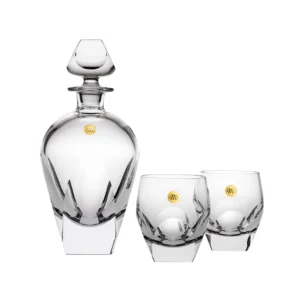
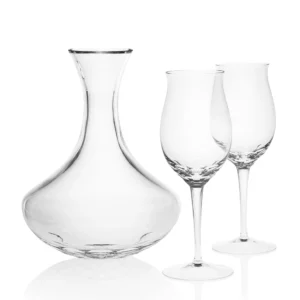
Several of our collections include matching decanter + glass sets, such as our Bouquet wine set by Moser or our Solaris decanter + 2 whisky glasses gift set, distinguished by a magnificent 24-carat gold mirror finish at the base of each piece.
Just like fine spirits, which deserve to be treated with care, crystal is a delicate material that needs to be handled and looked after like a diva.
We’re not going to repeat our entire guide to cleaning crystal, but here are a few rules worth remembering…
For Everyday Cleaning:
1: Clean your decanter immediately after use to prevent stubborn marks & deposits left by alcoholic drinks.
2: Always wash your decanter by hand. Crystal is fragile, and a dishwasher could damage or break your decanter. Not to mention ruining it with overly harsh cleaning chemicals.
3: Never use hot water: crystal doesn’t cope well with sudden temperature changes. Instead, add a few drops of black soap to lukewarm water at 30–35°C and fill your decanter with the mixture. Then swirl it gently.
4: Empty it and repeat with clean, lukewarm water to rinse.
5: Dry your decanter immediately: leaving it to air-dry can leave faint limescale marks from tap water. To dry the inside, wrap a microfibre or linen cloth around a soft bottle brush (or better still, a bamboo stick) to avoid scratches.
AND ABOVE ALL:
6: If your decanter is made from lead crystal, don’t leave wine, whisky or cognac inside between meals, for example. Prolonged contact would give the acidity of the drink time to “attack” the crystal, potentially encouraging lead to leach into your drink. But with lead-free crystal decanters like those we offer on this page, this isn’t an issue.
And for Occasional Deep Cleaning (removing limescale, restoring shine, etc.), click here for our complete cleaning & care guide.
A genuine crystal decanter can be identified by its weight (around 30% heavier than glass), its clear, long-lasting ring, its rainbow-like refraction in natural light and the precision of its cuts (sharp, almost knife-like edges). Signed pieces also bear a maker’s mark engraved underneath the base.
NO, absolutely not. Especially since most crystal manufacturers now produce lead-free crystal. For older lead crystal decanters, simply avoid storing alcohol in them for more than 1 week to prevent lead leaching due to acidity.
5 simple rules: never use a dishwasher. Only use a mixture of lukewarm water (30–35°C) and a few drops of black soap. Then dry immediately with a microfibre cloth wrapped around a bamboo stick to avoid scratches.